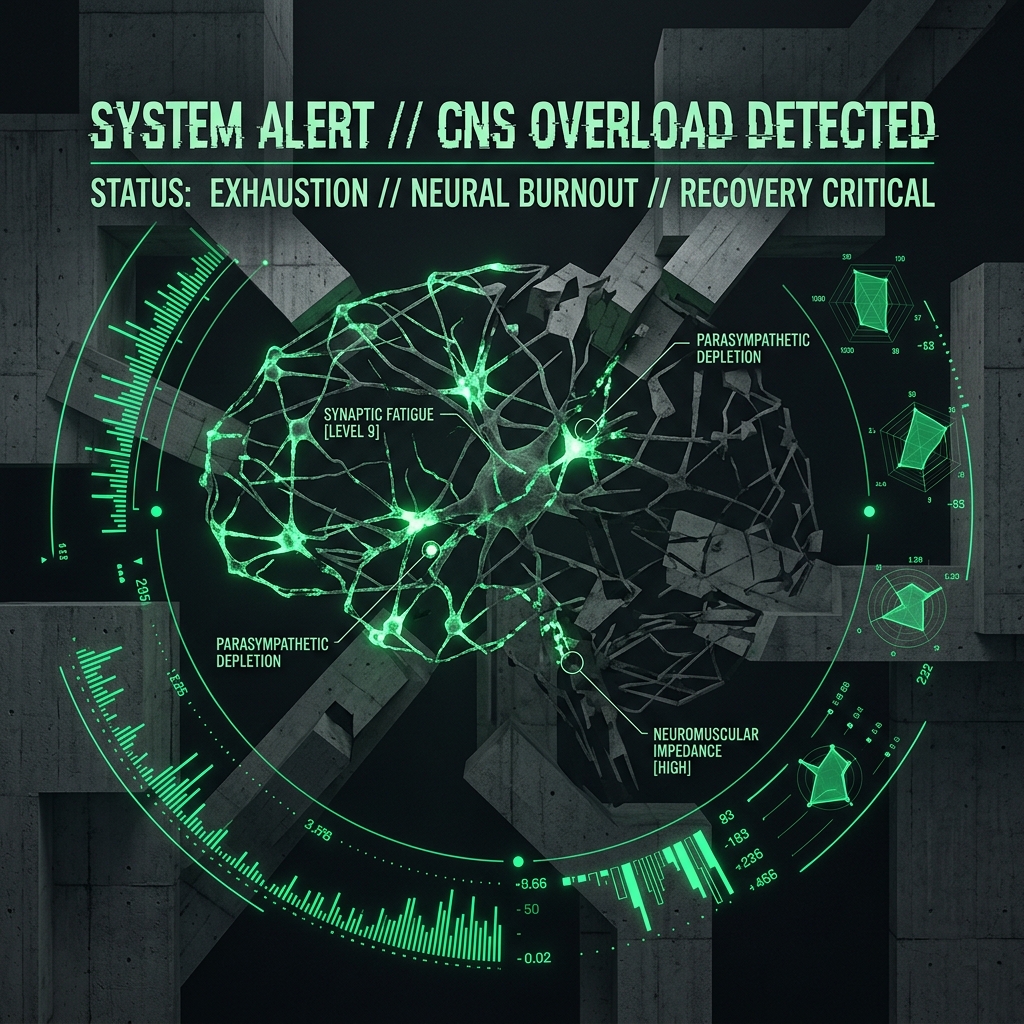
CNS Burnout: The Invisible Wall of Overtraining
When an athlete pushes past their physiological limits, the immediate assumption is peripheral fatigue—the muscles are damaged, glycogen stores are depleted, and local metabolites have accumulated. But if you are failing lifts you previously crushed, and your muscles feel adequately recovered, you haven't hit a muscular failure point. You've hit the invisible wall of CNS Burnout.
Stop guessing, look at the data. Central nervous system overreaching is a neuroendocrine crisis that demands a clinical approach to recovery, not just another rest day.
The Physiology of Neural Drive
Voluntary muscle contraction begins in the motor cortex. The brain sends an electrical impulse down the spinal cord and across the neuromuscular junction to recruit motor units. This electrical signal is referred to as "neural drive."
During periods of high-volume, high-intensity training (particularly heavy compound movements or explosive plyometrics), the demand on the CNS is astronomical. Over time, without adequate autonomic recalibration, the motor cortex actively reduces neural drive to protect the organism from catastrophic mechanical failure. This is central fatigue.
Your muscles may have the contractile capacity to lift the weight, but the brain refuses to send a strong enough signal to recruit the high-threshold motor units.
Clinical Markers of CNS Overreaching
Unlike DOMS, CNS burnout doesn't hurt. It is insidious. To detect it, you must monitor the correct biomarkers:
- Heart Rate Variability (HRV) Suppression: A sustained drop in HRV indicates that the autonomic nervous system is locked in sympathetic dominance (fight-or-flight) and is failing to engage the parasympathetic rest-and-digest pathways.
- Decreased Grip Strength: The CNS heavily innervates the hands. A sudden drop in maximal isometric grip strength is a validated proxy for global central fatigue.
- Altered Sleep Architecture: As discussed in the REM Sleep Tax, hyperarousal prevents the onset of Slow-Wave Sleep, creating a vicious cycle of incomplete neurological repair.
- Mood Disturbances: Neurotransmitter depletion, specifically of dopamine and serotonin, often manifests as lethargy, apathy, and a stark lack of motivation to train.
Rewiring the System
You cannot "push through" CNS burnout. Attempting to do so risks cascading into Non-Functional Overreaching (NFOR) or Overtraining Syndrome (OTS).
Recovery requires a multidimensional approach: deloading to reduce absolute intensity (often dropping volume by 50%), prioritising high-quality sleep, and modulating carbohydrate intake to support neurotransmitter synthesis. Respect the invisible wall—because if you don't manage your neural drive, your nervous system will manage it for you.