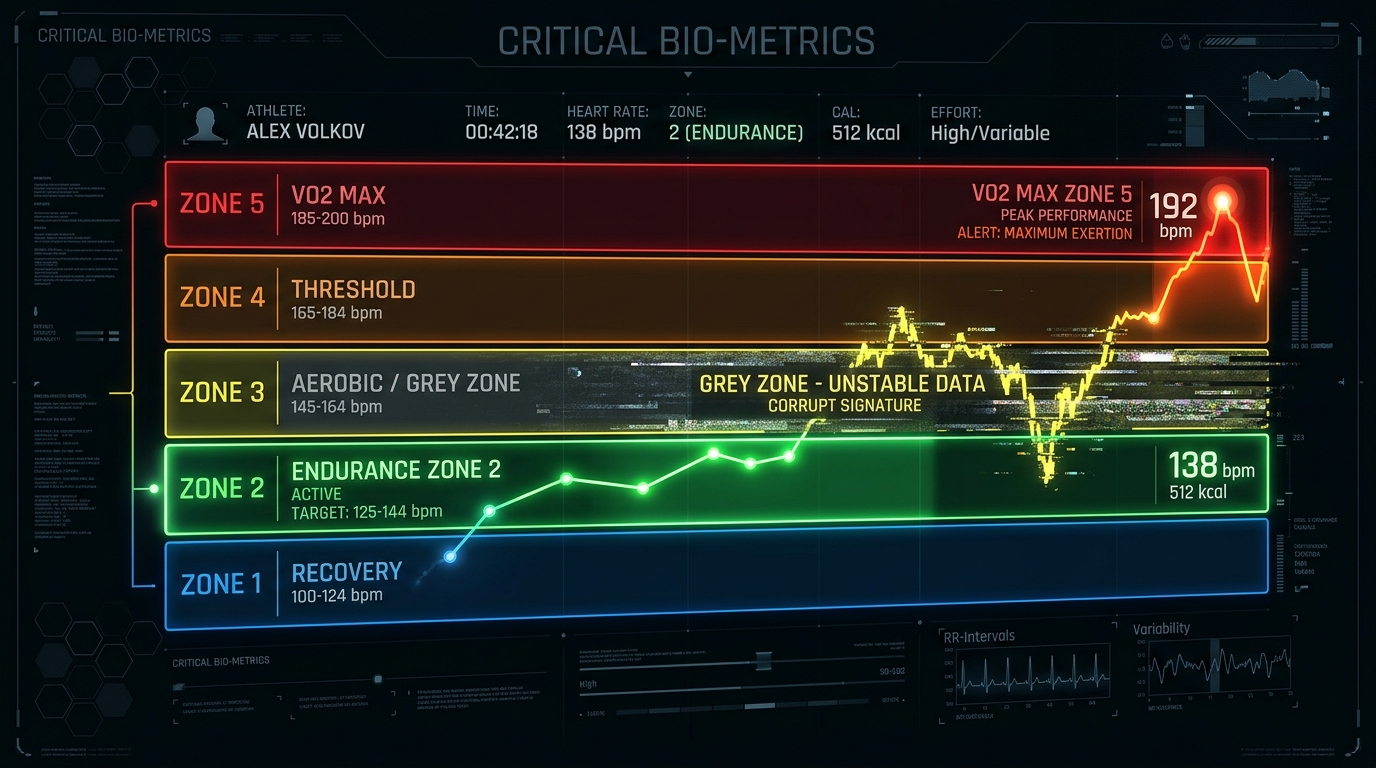
The Engine Hierarchy: Understanding Heart Rate Zones
The fitness industry has a massive ego problem. People believe that if a workout didn't leave them gasping for air in a pool of their own sweat, it wasn't effective.
This mentality is why 90% of amateur athletes are overtrained, injured, and entirely stagnant in their cardiovascular development.
To build a true, elite-level biological engine, you must understand the clinical reality of Heart Rate Training. Your heart is a muscle, but it responds very differently depending on the electrical frequency (BPM) at which you force it to operate.
Here is the science behind the 5 Heart Rate Zones, the good, the bad, and the outright destructive.
Zone 1: Active Recovery (50-60% Max HR)
The Vibe: A brisk walk. You can breathe entirely through your nose and hold a conversation for hours. The Biology: This zone promotes blood flow without accumulating any systemic fatigue. It physically flushes metabolic waste (lactic acid) from muscle tissue. The Application: Use this on rest days. It is not "training"; it is active healing.
Zone 2: The Aerobic Base (60-70% Max HR)
The Vibe: A slow jog or steady cycle. It feels almost annoyingly slow. If someone ran past you, you would have to swallow your ego to let them go. The Biology (The Good): This is the holy grail of longevity and engine building. Training exclusively in Zone 2 forces the body to build new mitochondria (the powerhouses of the cell) and physically stretches the left ventricle of the heart, allowing it to pump more blood per beat. Because the intensity is low, it utilises fat oxidation for fuel rather than glycogen. The Application: 80% of your total weekly cardiovascular volume should be spent strictly in Zone 2.
Zone 3: The Grey Zone (70-80% Max HR)
The Vibe: A moderately hard run. You are sweating, breathing heavily, but you aren't sprinting. This is the pace 99% of people run at naturally. The Biology (The Ugly): Welcome to the most destructive zone in fitness. In Zone 3, you are running too fast to efficiently build mitochondrial density (losing the benefits of Zone 2), but you are running too slow to force VO2 Max adaptations (losing the benefits of Zone 5). The Reality: All you are doing in Zone 3 is accumulating massive central nervous system fatigue, spiking cortisol, and causing joint stress, with virtually zero biological return on investment. These are Junk Miles. Avoid Zone 3 at all costs.
Zone 4: The Threshold (80-90% Max HR)
The Vibe: Burning lungs. You are at the very edge of your sustainable capacity. You can sustain this for maybe 15-30 minutes if your life depended on it. The Biology: You cross the "Lactate Threshold." Your body is producing lactic acid faster than it can clear it. Training here teaches your body how to buffer acid and sustain high speeds for longer durations. The Application: Highly specific to endurance racers (marathoners, cyclists). Use sparingly (10% of total volume) as it requires significant recovery.
Zone 5: Maximum Capacity (90-100% Max HR)
The Vibe: An all-out sprint for your life. You cannot sustain this for more than 2-4 minutes. The Biology (The Great): This is where VO2 Max is built. You are forcing the heart to operate at absolute maximum capacity, increasing the sheer volume of oxygen your blood can carry. A high VO2 Max is the single greatest predictor of human longevity and all-cause mortality. The Application: 10% of your total weekly volume. Use strict protocols like the Norwegian 4x4 (4 minutes at max effort, 4 minutes recovery).
The Verdict: Polarized Training
Stop living in the Grey Zone. If you want to build a truly elite cardiovascular engine, you must implement Polarized Training.
Keep your easy days incredibly easy (Zone 2), and your hard days brutally hard (Zone 5). Anything in between is just feeding your ego at the cost of your biology.