The Core Delusion: Why Crunches Destroy Your Lower Back
The Core Delusion: Why Crunches Destroy Your Lower Back
In the fitness industry, dogma often outpaces clinical data. Nowhere is this more apparent than in the prescription of the traditional crunch or sit-up for "core strengthening." The underlying physiology and mechanical load profiles of these movements reveal a stark truth: we are systematically destroying the lumbar spine under the guise of fitness. Stop guessing, look at the data.
The Biomechanics of Lumbar Flexion
The human lumbar spine consists of vertebrae separated by intervertebral discs. These discs have a tough outer ring (annulus fibrosus) and a gel-like centre (nucleus pulposus). When the spine undergoes repeated flexion under compressive load—exactly what happens during a crunch—the nucleus pulposus is pushed posteriorly against the annulus fibrosus.
Clinical research, most notably by Dr. Stuart McGill, has demonstrated that repeated cycles of flexion under compression are the primary mechanism for disc herniation. The crunch places approximately 3,300 Newtons of compressive force on the lumbar spine. Over time, this repetitive stress delaminates the annular fibres, leading to bulging or herniated discs.
Core Stability vs. Spinal Flexion
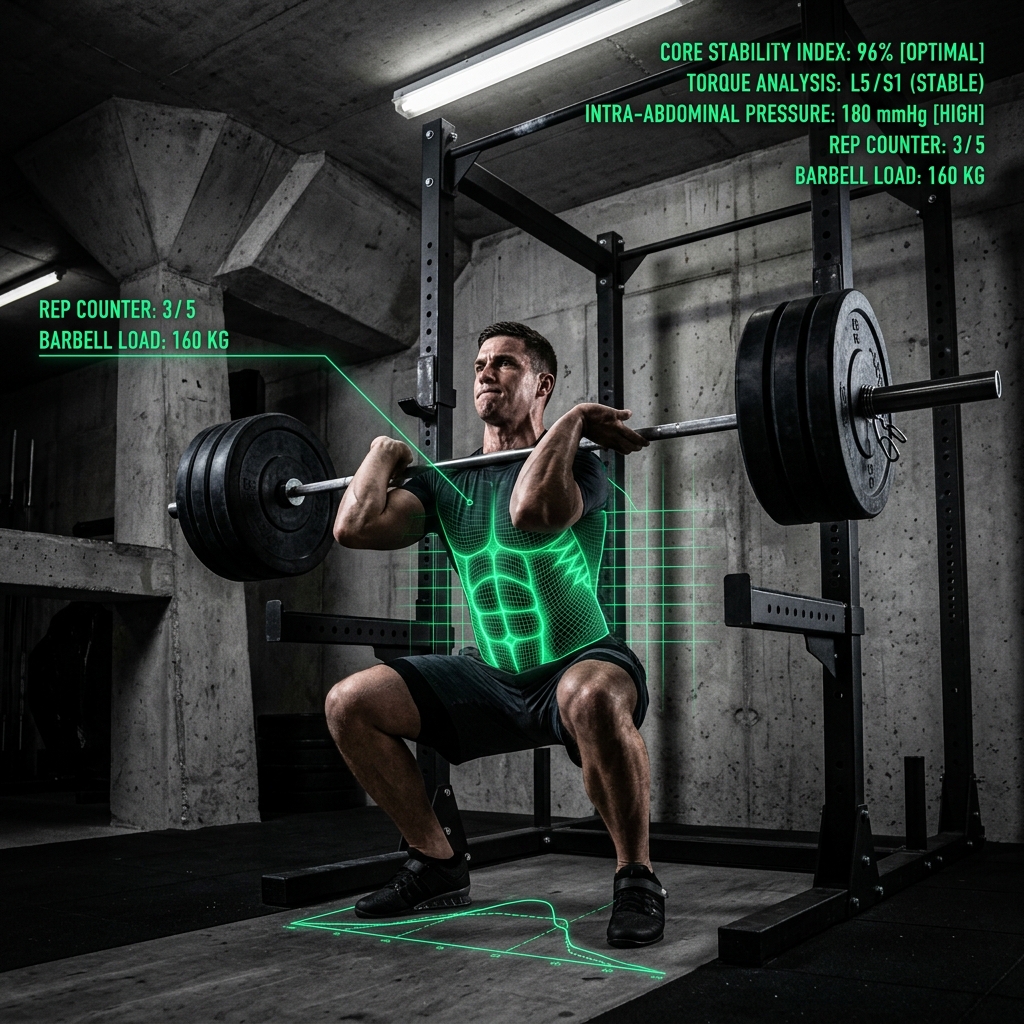
The true function of the core musculature is not to generate spinal flexion, but rather to prevent unwanted motion (anti-extension, anti-flexion, and anti-rotation). The abdominal fascia, transversus abdominis, internal/external obliques, and rectus abdominis act as a biological guy-wire system. They stabilise the spinal column so that force can be efficiently transmitted between the upper and lower extremities.
By training the core through active flexion (crunches), we are training the spine to buckle under load. Conversely, exercises like the McGill Big 3 (curl-up, side plank, and bird-dog) train the musculature to brace effectively, increasing the margin of safety for the spine.
A Data-Driven Prescription
To optimise core strength while preserving spinal integrity, the training paradigm must shift from dynamic flexion to isometric stabilization.
- Eliminate: Crunches, sit-ups, and GHD sit-ups.
- Implement: Isometric bracing exercises (planks, pallof presses, loaded carries).
- Progress: Increase the lever arm or the required anti-rotational force, rather than the range of spinal motion.
We must align our training methodologies with clinical biomechanics. The data is unequivocal: prioritise spinal stability, and abandon the crunch.