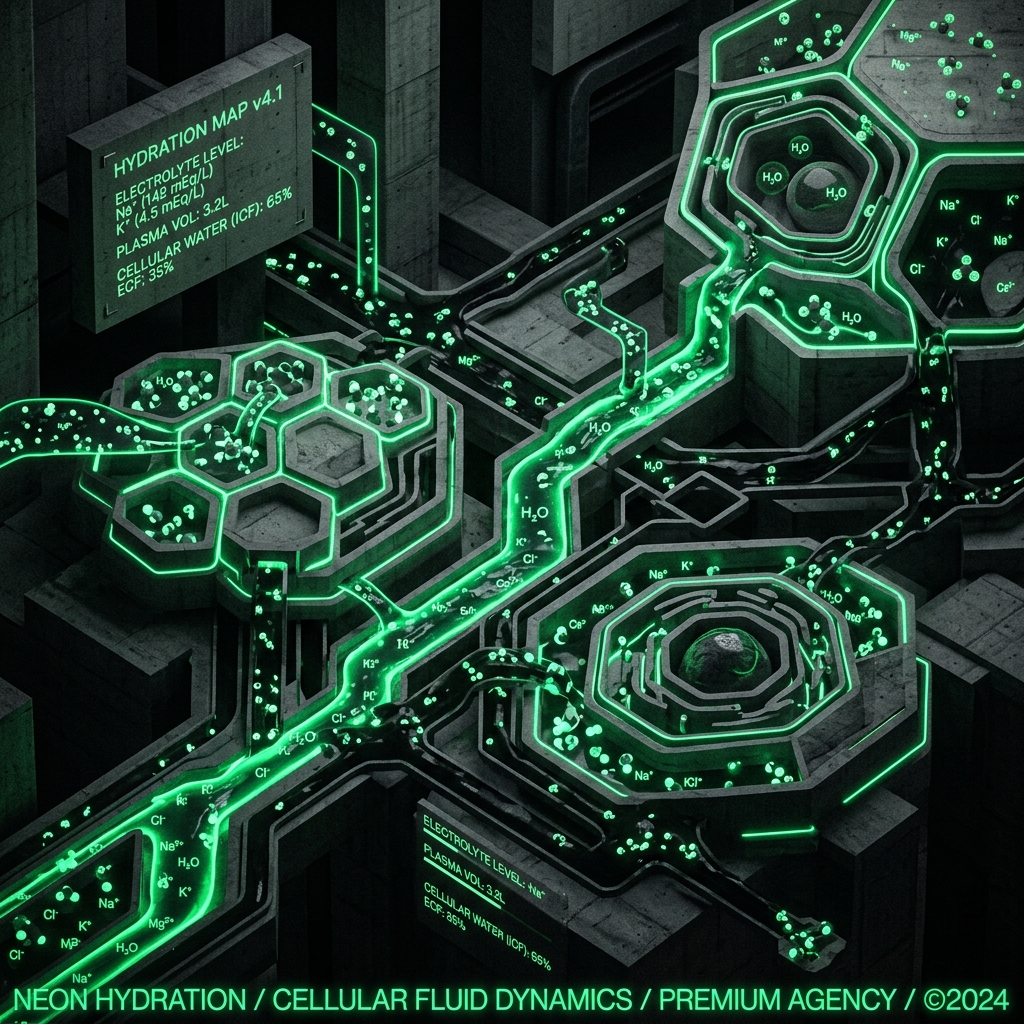
The Hydration Multiplier: Electrolytes and Muscular Output
Stop guessing, look at the data. The fitness industry often treats hydration as a simple matter of drinking a gallon of plain water a day. This is a fundamental misunderstanding of clinical physiology.
Hydration is not merely about water volume; it is about fluid distribution and electrical gradients. When you consume plain water devoid of electrolytes, you dilute extracellular osmolality. This can lead to hyponatremia and a decrease in performance. True hydration requires a precise balance of sodium, potassium, and water to optimise muscular contraction and cellular signalling.
The Physiology of Action Potentials
Muscular contractions do not happen by magic; they are electrical events. The resting membrane potential of a muscle cell is maintained by the sodium-potassium pump (Na+/K+-ATPase), which actively pumps sodium out of the cell and potassium in.
When a motor neuron signals a muscle to contract, voltage-gated sodium channels open, allowing an influx of sodium that depolarises the cell membrane. This action potential triggers the release of calcium from the sarcoplasmic reticulum, initiating the sliding filament mechanism of muscle contraction. If extracellular sodium is inadequate, the amplitude of the action potential is blunted, leading to decreased force production and premature fatigue.
Cellular Swelling as an Anabolic Signal
Furthermore, intracellular hydration dictates cellular volume. When muscle cells are properly hydrated (which requires adequate sodium and potassium to draw water in), they swell.
This cellular swelling is not just cosmetic; it is an independent anabolic signal. Research indicates that an increase in cell volume stimulates protein synthesis and inhibits protein breakdown, likely mediated by mTOR pathway activation. Conversely, cellular dehydration signals a catabolic state.
The Role of Sodium in Fluid Retention
The dogma that sodium should be universally restricted is outdated. For the hard-training athlete, sodium is the ultimate performance enhancer. It is the primary osmole in the extracellular fluid, meaning it dictates blood volume.
Higher blood volume translates to improved cardiovascular efficiency, better heat dissipation, and enhanced nutrient delivery to working muscles. Studies show that pre-exercise hyperhydration with sodium can significantly improve time-to-exhaustion and power output, particularly in hot environments.
The Protocol: Strategic Replenishment
Stop chugging plain water during your gruelling sessions.
- Pre-Workout Loading: Consume 500-1000mg of sodium with 16-24oz of water roughly 30-60 minutes before training to optimise blood volume and initiate cellular swelling.
- Intra-Workout Maintenance: If the session is intense and sweaty, include 300-600mg of sodium per hour of exercise, alongside potassium and magnesium, to maintain action potential fidelity.
- Daily Baseline: Do not restrict salt unless medically indicated. Salting your food to taste is usually sufficient for baseline needs, provided you are tracking performance markers.
Optimise your electrical gradients. The data demands it.